
Indian higher education is going through a structural shift that has less to do with brand names and more to do with how people actually learn today. The National Education Policy's emphasis on flexible entry and exit, the introduction of the National Credit Framework, and the University Grants Commission's approval for well-established universities to run full online degree programmes have together changed what a degree is expected to deliver. It is no longer enough for a degree to certify knowledge alone; employers, families and learners increasingly expect it to certify capability. This is precisely the gap that apprenticeship-embedded online degrees are designed to close: coursework delivered online, paired with structured, real-world apprenticeship exposure, so that a graduate leaves with both a transcript and a track record.
The more immediate and more practical question for most readers, however, is simpler: who should choose AMU online programmes, and is this format actually suited to their situation? The honest answer depends less on ambition and more on circumstance: how much time a person can realistically commit, what stage of life they are in, and what outcome they are trying to reach. The sections below work through that decision methodically.
- What an Apprenticeship-Embedded Online Degree Actually Involves
- Reading the Learner Profile: Who Actually Fits This Model
- What This Path Offers Beyond the Certificate
- What Families Should Weigh Before Encouraging This Decision
- Eligibility at a Glance
- Career Direction: Where This Degree Can Lead
- The Readiness–Relevance–Reach Framework: A Self-Check Before Enrolling
- Bachelor's or Master's: Choosing the Right Entry Point
- Where This Model Is Headed
- Making the Decision
- Frequently Asked Questions
What an Apprenticeship-Embedded Online Degree Actually Involves
Most people assume an online degree is simply a classroom moved onto a screen. The apprenticeship-integrated model is structured differently. Alongside online coursework, learners are placed into a structured apprenticeship component that gives them applied, workplace-facing experience while they study an arrangement that mirrors how professional degrees increasingly combine theory with practice rather than separating the two.
The undergraduate route is offered as a Bachelor of Arts with Apprenticeship, with specialisation choices spanning English, Economics, Hindi, History, Political Science and Urdu, alongside a Bachelor of Commerce with Apprenticeship. At the postgraduate level, the same apprenticeship-linked structure carries into a Master of Arts with Apprenticeship again across English, Economics, Hindi, History, Political Science and Urdu and a Master of Commerce with Apprenticeship.
This design changes the underlying value proposition. A learner is not simply acquiring subject knowledge; they are acquiring subject knowledge that has been tested against real tasks, which is what most hiring conversations in India now screen for.
Reading the Learner Profile: Who Actually Fits This Model
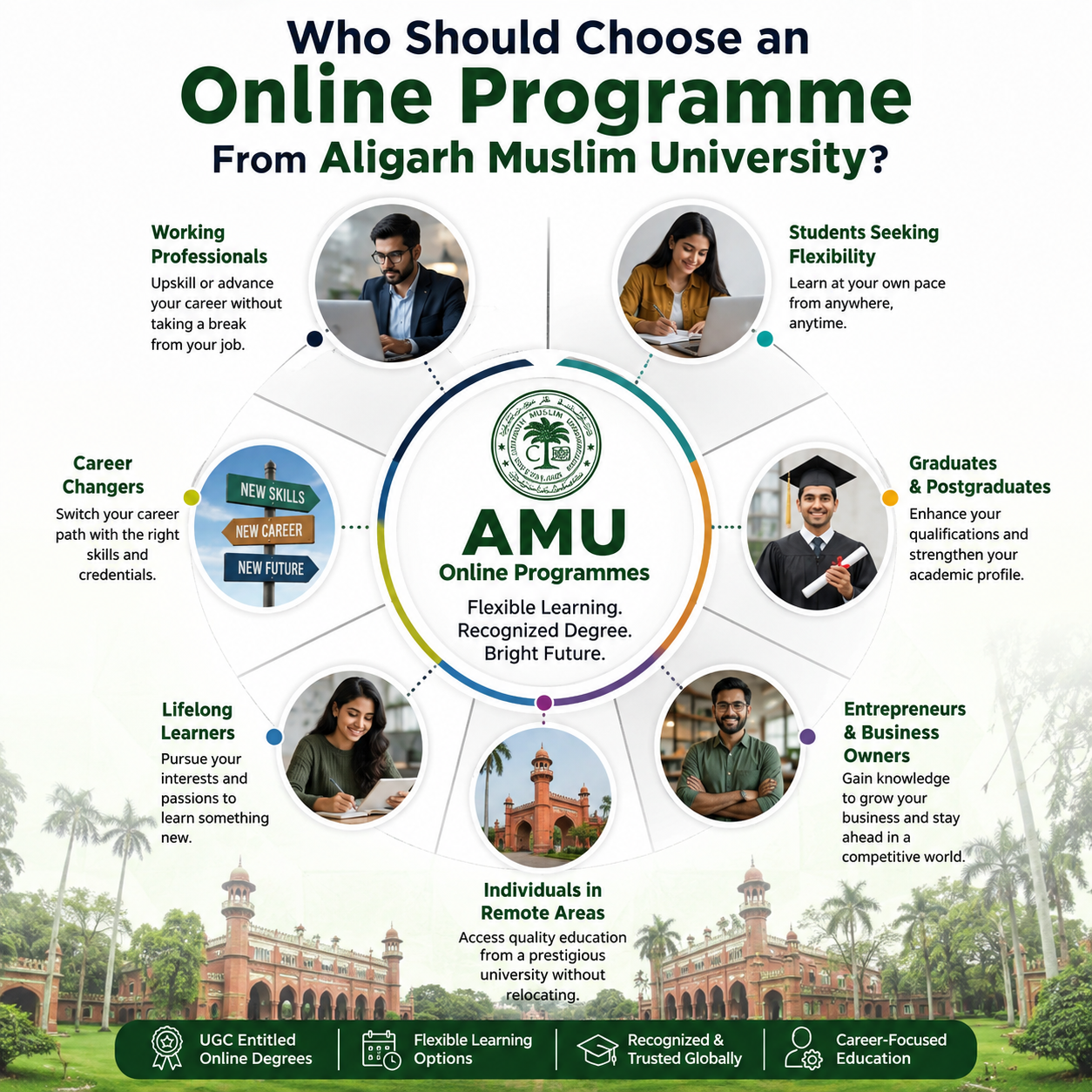
Not every format suits every learner, and this one has a fairly identifiable profile. AMU online programmes for graduates tend to work best for people who fall into one or more of the following categories:
- Recent undergraduates who want workplace exposure built into their degree rather than added on afterwards
- Working professionals who need to upskill or requalify without stepping away from a salary
- Career changers moving from one field into humanities, commerce or public-facing roles
- Learners based outside metro cities who do not want relocation to be a precondition for a recognised degree
- Individuals managing caregiving or family responsibilities who need control over when and how they study
- Government exam aspirants who want a formally recognised degree running parallel to their preparation
What unites these profiles is not ambition level but constraints of time, geography or income limitations that a rigid, campus-bound format does not accommodate.
Recognising a fit in the list above? There is no need to guess further; the fastest way to confirm suitability is to look directly at what is on offer. Explore the online programmes at Aligarh Muslim University and compare specialisations against personal goals before deciding.
What This Path Offers Beyond the Certificate
The case for this format rests on more than convenience. When learners weigh the benefits of studying online at AMU, several advantages tend to surface consistently:
- Flexibility to study around a job, family responsibilities, or existing exam preparation
- Lower overall cost of pursuing a degree compared to full-time, on-campus enrolment
- Practical exposure built in through the apprenticeship component, rather than left to chance after graduation
- No requirement to relocate, which widens access for learners outside major cities
- Structured pacing that still allows self-directed study rather than rigid classroom timing
- A recognised university credential attached to a modern, skills-integrated delivery model
What Families Should Weigh Before Encouraging This Decision
Families considering this route for a son, daughter or dependent are usually less concerned with the format and more concerned with substance: whether the degree is properly recognised, whether the faculty is qualified, and whether it leads somewhere concrete. These are reasonable questions and deserve direct answers rather than reassurance alone. A degree issued by an established, UGC-recognised university carries the same academic weight regardless of delivery mode, provided the programme itself is approved for online delivery. What changes is not the credential's legitimacy but the pathway to earning it.
AMU online learning suitability, from a family's point of view, ultimately comes down to whether the apprenticeship component gives a young learner enough structured accountability to complete the programme with discipline, something that matters as much to parents as the subject matter itself.
Eligibility at a Glance
- Bachelor of Arts / Bachelor of Commerce with Apprenticeship: a Higher Secondary Certificate recognised by the university
- Master of Arts with Apprenticeship: a B.A., B.Sc. or B.Com from a recognised university
- Master of Commerce with Apprenticeship: a B.Com from a university or institute recognised by the university
Still weighing eligibility, specialisations or the application process? There is no need to work it out alone; reach the AMU Helpline Number for Admission for direct, programme-specific guidance before applying.
Career Direction: Where This Degree Can Lead
Prospective learners usually want a straightforward answer to a practical question: what does this degree actually lead to? When evaluating an AMU online degree for career growth, the honest answer is that outcomes vary by specialisation but follow identifiable patterns.
Humanities specialisations English, History, Political Science, Urdu and Hindi commonly open doors toward:
- Content writing and editorial roles
- Translation and language services
- Civil services and public administration preparation
- Journalism and media research
- Teaching and academic support roles, subject to further qualification where required
- Policy research and NGO programme roles
Economics and Commerce specialisations commonly open doors toward:
- Business analysis and research roles
- Accounting and tax advisory support
- Banking and financial services operations
- Business development and client-facing roles
- Data-driven roles in market and industry research
The Readiness–Relevance–Reach Framework: A Self-Check Before Enrolling
Rather than relying on generic advice, it helps to run any online degree decision through three consistent checkpoints referred to here as the Readiness–Relevance–Reach framework.
Readiness: Can the learner realistically commit consistent weekly hours to both coursework and the apprenticeship component without it collapsing under existing commitments?
Relevance: Does the specific specialisation connect to a career direction the learner already has, rather than a vague sense that a degree will help?
Reach: Does the online, apprenticeship-integrated format solve a genuine access problem geography, cost or timing that a conventional on-campus degree would not?
A learner who can answer all three positively is generally a strong fit for this format. A weak answer on any one axis is not necessarily disqualifying, but it is worth resolving before enrolment rather than after.
Bachelor's or Master's: Choosing the Right Entry Point
Deciding between the two entry points is often where the question, " Is AMU online education suitable for me?" is actually resolved, since eligibility and readiness look different at each stage.
| Aspect | Bachelor's Track | Master's Track |
|---|---|---|
| Programmes | BA with Apprenticeship (six specialisations), B.Com with Apprenticeship | MA with Apprenticeship (six specialisations), M.Com with Apprenticeship |
| Eligibility | Higher Secondary Certificate recognised by the university | Relevant bachelor's degree from a recognised university (B.A./B.Sc./B.Com for the MA route; B.Com for the M.Com route) |
| Best suited for | School leavers, early-career starters, first-time degree seekers | Graduates seeking specialisation, career changers, working professionals upskilling |
| Apprenticeship focus | Foundational workplace exposure and professional habits | Domain-specific, higher-responsibility applied projects |
| Typical outcome | Entry-level roles paired with a formal degree | Career acceleration, role transition, or eligibility for advanced positions |
Where This Model Is Headed
The broader direction of Indian higher education favours exactly this kind of hybrid design. As the National Credit Framework matures, credits earned through apprenticeship-linked programmes are expected to stack and transfer more easily across institutions, and employers are steadily moving toward hiring practices that credit demonstrated experience alongside academic scores. Framed this way, the wider AMU online education benefits are not really about convenience at all; they are about being positioned early inside a model of higher education that the rest of the system is still catching up to.
Making the Decision
Ultimately, the right decision has little to do with trends or convenience and everything to do with fit, time available, career direction, and whether structured, apprenticeship-linked learning solves a genuine constraint. For the right learner, this format offers a rare combination: a recognised degree, applied experience, and the flexibility to pursue both without pausing life in the process.