
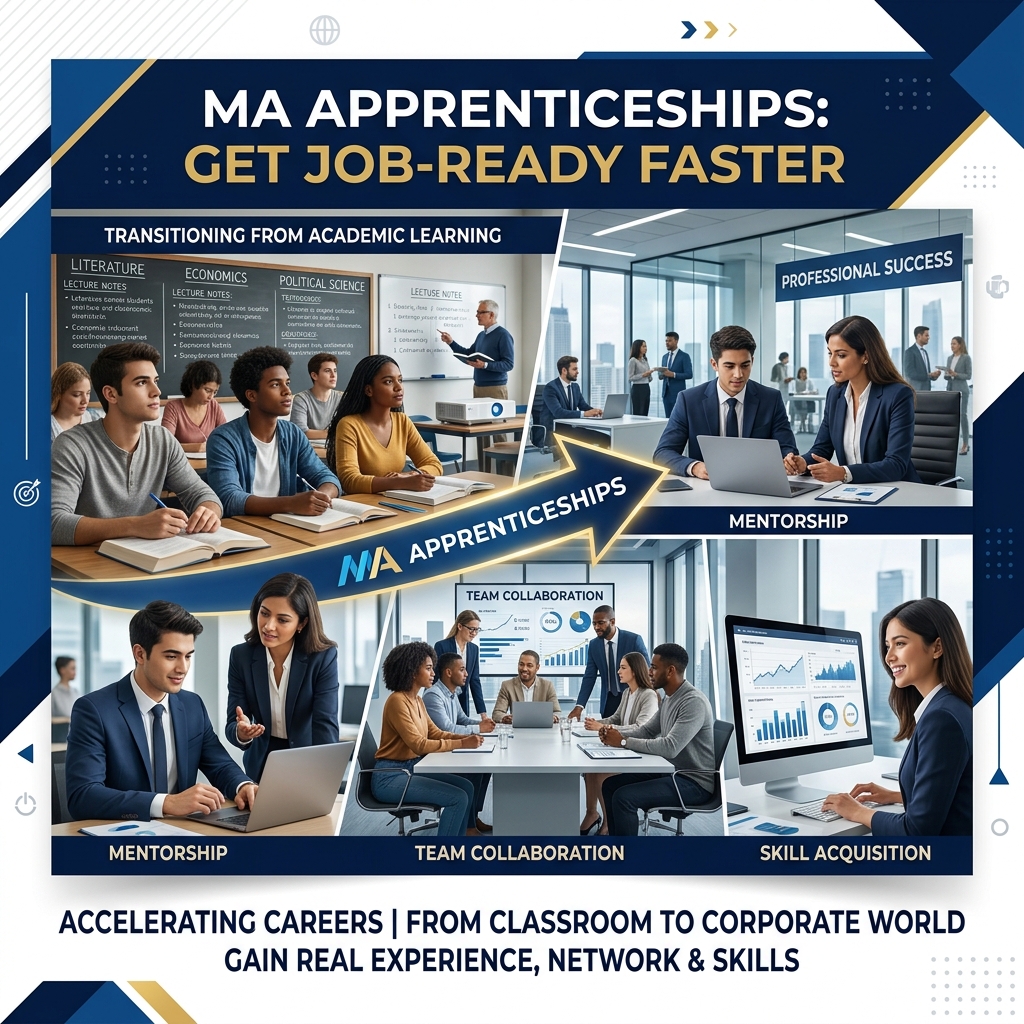
There is a specific kind of frustration that hits many MA graduates in their first year of job searching. They have spent two years studying at a high level, reading deeply, writing analytically, and building arguments that their professors respected. They can hold a complex idea across twenty pages. They understand theory, context, and nuance.
And then they sit across from an interviewer who asks, “Can you walk me through a project you managed?” or “Tell me about a time you worked under pressure in a professional environment.” And the honest answer is: they cannot. Not because they are incapable, but because no one ever put them in that situation.
This is not a skills gap in the traditional sense. It is an exposure gap. Postgraduate study, particularly in the arts and humanities, has historically treated professional application as something that happens after the degree, not during it. The assumption was that academic excellence would translate naturally into workplace readiness. In most cases, it does not, at least not fast enough to matter in a competitive hiring environment.
The shift that is worth paying attention to: employers have become significantly more precise about what they want from postgraduate hires. A strong degree from a credible institution is the floor, not the ceiling. What they are actually assessing is whether the candidate has demonstrated the ability to function in a professional context. That is a very different thing from academic performance, and it is the thing that an apprenticeship directly addresses.
- What an Apprenticeship Actually Changes Beyond the CV Line
- The Real Conversations Happening Between Students and Employers Right Now
- Who Benefits Most From This Format and What Gets Missed Without It
- Six Specialisations, One Consistent Advantage
- The Skills That Actually Transfer From Campus to Career
- Where the Postgraduate Employment Market Is Heading
- What to Take Into Your Decision
- Frequently Asked Questions
What an Apprenticeship Actually Changes Beyond the CV Line
The most common misconception about apprenticeships is that they are primarily a credential add-on. Something to write on a CV to make a humanities degree look more employable. This misses the deeper mechanism entirely.
What an apprenticeship changes is the student’s relationship to professional contexts. Before structured workplace exposure, the typical postgraduate student experiences professional environments as a visitor attending a seminar, doing a short internship, or shadowing someone for a week. These experiences are useful, but they do not change behaviour because they carry no sustained accountability.
An apprenticeship embedded in a degree programme carries accountability. There are deliverables. There are supervisors who are not academics. There are deadlines that exist in a professional context, not an academic one. There are moments when the student has to navigate ambiguity, disagreement, or failure without the safety net of a grade curve. This is what job-ready skills through MA apprenticeship actually mean, not a list of competencies, but a genuine shift in how a student operates when the environment demands it.
The Real Conversations Happening Between Students and Employers Right Now
A common pattern in postgraduate hiring: the candidate with a strong academic record who interviews well on content but hesitates on application. They can explain a theory fluently but struggle to connect it to a decision they would make in practice. Hiring managers notice this immediately, and they have become less patient with it as the pool of candidates with practical experience has grown.
For fresh graduates, the challenge is compressing the credibility gap. The typical employer timeline expects a new hire to contribute meaningfully within weeks of joining. A candidate who has spent the final year of their MA functioning inside a professional environment managing real tasks, navigating real relationships, and producing real outputs has already been through that compression. Their learning curve is shorter because the curve has already happened.
For working professionals returning to postgraduate study, the challenge is different but equally real. Many are studying specifically to change sectors, move into leadership, or gain credentials for roles they are already capable of but cannot access without the qualification. The practical learning experience embedded in an apprenticeship accelerates this transition by giving them a structured context to demonstrate new capabilities not just to future employers, but to themselves.
The industry exposure for students that an apprenticeship provides is not simply about learning how an organisation works. It is about learning how you work inside an organisation, which is information that no amount of academic study can substitute for, and which employers can detect within the first ten minutes of an interview.
🎓 Explore the Programme and Specialisations
Explore the academic curricula, professional placement design, and specialized streams available under the Aligarh Muslim University online MA with Apprenticeship.
Who Benefits Most From This Format and What Gets Missed Without It
The MA apprenticeship and employability connection is strongest for specific profiles. Understanding where this model delivers the most impact helps students make a more informed decision about whether the investment of time and effort is right for them.
This format delivers the clearest benefit to:
- Fresh graduates who have strong academic records but limited professional experience and want to close that gap before entering the job market.
- Working professionals who are upskilling to change sectors and need a structured environment to demonstrate new capabilities, not just list new qualifications.
- Students in arts and humanities disciplines, where the professional application of the subject is less self-evident and needs active bridge-building.
- Candidates targeting competitive roles in civil services, policy, media, education, or research where demonstrated application matters as much as the degree itself.
- Anyone who has experienced the frustration of being academically qualified but professionally unproven in an interview setting.
What gets missed without structured workplace integration:
- The ability to manage professional relationships and navigate workplace dynamics, which cannot be learned from a textbook or simulated in a seminar.
- The professional reference that an employer in the relevant sector can provide, which is qualitatively different from an academic reference.
- The self-knowledge that comes from functioning under real professional pressure, knowing how you perform, where you default, and what you need to develop.
- The sector-specific context that makes a generalist MA immediately legible to employers in a specific field.
Six Specialisations, One Consistent Advantage
The career readiness through apprenticeship that this model provides is not subject-specific; it is structural. Each of the six MA specialisations available with apprenticeship integration delivers the same core professional development through a subject-specific lens. The academic content differs. The workplace readiness mechanism is the same.
Six MA Specialisations and Career Directions
| Programme | Career Directions |
|---|---|
| MA English with Apprenticeship | Content strategy, media, publishing, communications, language education |
| MA Economics with Apprenticeship | Policy research, banking, financial analysis, development sector, consulting |
| MA Hindi with Apprenticeship | Media, translation, content creation, education, government communications |
| MA History with Apprenticeship | Heritage management, research, civil services, education, archiving |
| MA Political Science with Apprenticeship | Policy analysis, journalism, civil services, NGOs, public administration |
| MA Urdu with Apprenticeship | Translation, literary research, media, diplomacy, education |
The pattern worth noting: every specialisation in this programme connects to sectors that are actively hiring postgraduates with demonstrated professional capability. None of these is fields where the degree alone is sufficient for advancement. In each case, the employer is looking for evidence that the candidate can function, not just theorise. The apprenticeship provides that evidence.
The workplace skills development built into each specialisation is calibrated to the professional contexts most relevant to that subject area. A student in MA Economics is not developing the same workplace skills as a student in MA Urdu, but both are developing the professional literacy, communication capabilities, and sector awareness that their respective employers require.
The Skills That Actually Transfer From Campus to Career
The hands-on learning experience of an apprenticeship produces a specific set of capabilities that academic study, however rigorous, consistently struggles to develop. These are not soft skills in the dismissive sense of that phrase; they are the operational competencies that determine whether a graduate functions effectively in a professional environment from the first week.
Key Skills Developed Through Apprenticeships
| Skill Developed | What It Looks Like in Practice |
|---|---|
| Professional communication | Writing, presenting, and articulating ideas in workplace contexts |
| Stakeholder navigation | Working with supervisors, colleagues, clients, and institutions |
| Research application | Translating academic inquiry into practical deliverables |
| Time and project management | Meeting deadlines, managing workloads across academic and professional demands |
| Sector knowledge | Understanding how specific industries function from the inside |
| Self-directed learning | Developing the habit of initiative, reflection, and continuous development |
What makes this list significant is not that these skills are impossible to develop through academic study. It is that academic study develops them in a context that does not transfer cleanly. Writing a dissertation develops research and communication skills, but in a context where the audience is always the same, the feedback cycle is months long, and the stakes are personal rather than organisational. An apprenticeship develops the same underlying capabilities in a context that mirrors the one students will eventually work in.
Benefits Across the Student Journey
The benefits of MA apprenticeships for career readiness compound across three distinct phases of the student’s trajectory:
- During the programme: students develop confidence, sector knowledge, and a professional identity alongside their academic qualification. They arrive at their dissertation or final assessments with a richer body of real experience to draw on.
- At the point of graduation: they enter the job market with a credential and a professional record. Their CV reflects both what they know and what they have done. Their references span both academic and professional contexts.
- In the first two years of employment: the adjustment period that most graduates go through, learning how professional environments actually work, is compressed significantly. This translates directly into faster progression, greater confidence, and higher performance in early-career reviews.
The skills gained through MA apprenticeship programs do not expire. Unlike subject-specific knowledge that may need updating as fields evolve, the professional competencies developed through apprenticeship—communication, collaboration, initiative, and accountability—are exactly the capabilities that every employer in every sector consistently identifies as the most valuable and the hardest to find.
Job Roles Graduates Move Into Across Specialisations
- MA English: Content strategist, editorial associate, communications manager, copywriter, language educator, UX writer, corporate trainer
- MA Economics: Policy analyst, economic researcher, banking associate, financial consultant, development sector analyst, data interpreter
- MA Hindi: Content creator, media journalist, translator, language educator, government communications officer, scriptwriter
- MA History: Heritage consultant, archival researcher, civil services officer, museum associate, academic researcher, curriculum developer
- MA Political Science: Policy researcher, political analyst, civil services officer, NGO programme officer, journalist, public affairs consultant
- MA Urdu: Literary researcher, translator, cultural correspondent, education officer, diplomatic services associate, media professional
Where the Postgraduate Employment Market Is Heading
The workplace readiness skills that apprenticeships develop are becoming the primary differentiator in postgraduate hiring, not because academic quality no longer matters, but because academic quality has become a baseline expectation rather than a distinguishing factor. As more graduates enter the market with strong degrees from credible institutions, employers are increasingly assessing on the dimension that academic transcripts cannot capture: professional readiness.
Several directions are worth tracking for anyone making a postgraduate decision right now:
- Hybrid degree formats are expanding: Programmes that integrate academic and professional learning are increasing in both availability and employer recognition. Students who access these formats early benefit from a less crowded credential space.
- Sector-specific professional literacy is rising in value: Employers in policy, media, education, and research are increasingly distinguishing between candidates who understand their sector academically and those who understand it operationally. The latter are significantly harder to find.
- Professional references carry more weight: Academic references are necessary but no longer sufficient in competitive hiring. A professional reference from a supervisor in a relevant organisation developed through a structured apprenticeship provides a qualitatively different form of endorsement.
- Early career progression is concentrated among prepared graduates: The two-year post-graduation adjustment period that characterises many arts and humanities career starts is being compressed for candidates who enter with practical experience. First promotions, leadership track access, and salary progression are all moving faster for this cohort.
- Interdisciplinary application is growing: The ability to apply an MA specialisation across more than one sector, an economist working in policy and media, a political scientist working in NGOs and journalism, is a direct product of the broader professional context that an apprenticeship provides.
The career growth opportunities unlocked by this model are not hypothetical. They follow directly from the professional experience, verified capability, and expanded network that an apprenticeship creates. The students who invest in this format now are positioning themselves ahead of a shift in employer expectations that is already underway. The student career readiness question is ultimately a timing question. The gap between an academically qualified graduate and a professionally ready one exists for a period that is longer than most students expect. An apprenticeship integrated into the degree compresses that period significantly, and in a hiring market that rewards early demonstrators, that compression has real, lasting value.
What to Take Into Your Decision
- An apprenticeship does not add to your degree; it changes the quality of what the degree produces. The credential and the capability travel together.
- The gap between academic qualification and professional readiness is real, consistent, and costly in career terms. The apprenticeship model exists specifically to close it.
- Practical learning benefits of MA apprenticeships are most significant in arts and humanities disciplines where the professional application of the subject requires active demonstration, not just passive qualification.
- Fresh graduates and working professionals benefit from this format in different but equally valuable ways: early career confidence for the former, accelerated transition for the latter.
- The six specialisations available are each connected to active hiring sectors. The academic content is rigorous. The professional integration is structured. The career directions are specific.
Frequently Asked Questions
📞 Ready to Build Your Future at AMU?
Reach out to the Aligarh Muslim University admissions team directly for programme details, eligibility, and application guidance.
Enquire NowWant to know more about the Aligarh Muslim University? Reach out to the Aligarh Muslim University admissions team directly for programme details, eligibility, and application guidance.