
Commerce education has always been closely tied to how economies function — from trade and finance to accounting, compliance, and business operations. What has changed in recent years is not the relevance of commerce, but the way students prepare for professional roles within it. As organisations expect graduates to be job-ready from day one, the traditional boundaries between education and employability are steadily dissolving.
This shift has brought renewed attention to digitally delivered commerce programs that combine conceptual clarity with professional exposure. An online Bachelor of Commerce today is no longer a passive academic qualification; it is increasingly positioned as a structured pathway to skill development, workplace readiness, and early career momentum.
This blog explores how the program contributes to skill building and employability, the professional opportunities it opens up, and why it is emerging as a practical choice for today’s commerce students in India.
- The Evolving Landscape of Commerce Education
- Why Students Are Re-Evaluating Choices?
- Skill Development Outcomes
- Linking Education to Career Progression
- Career Pathways
- The Role of Internships and Work Exposure
- Program Design and Learning Experience
- Key Benefits of the Program
- Frequently Asked Questions
- Closing Perspective
The Evolving Landscape of Commerce Education
Commerce as a discipline has expanded far beyond textbook accounting and theoretical economics. Businesses now operate within complex regulatory environments, data-driven decision systems, and global supply networks. Graduates are expected to understand not just “what” to do, but “how” and “why” decisions are made across functions.
In this context, the scope of online B.Com degree programs has widened significantly. Instead of focusing only on subject mastery, modern programs emphasise applied understanding — how accounting links with compliance, how finance connects with risk, and how marketing aligns with consumer data and digital platforms.
At the same time, the online B.Com degree in India has gained acceptance among employers as institutions have strengthened curriculum design, assessment rigour, and industry integration. When delivered through recognised universities, these programs are increasingly viewed as credible academic pathways rather than alternatives of convenience.
Why Students Are Re-Evaluating Choices?
Many learners today are choosing to pursue commerce education alongside internships, apprenticeships, or entry-level roles. This has changed expectations from a B.Com program altogether.
The question is no longer only about earning a degree, but why choose an online B.Com program formats that allow learning to align with early professional exposure. Students want structured academics without putting career exploration on hold — and this is precisely where digitally delivered commerce education fits in.
Online programs allow learners to:
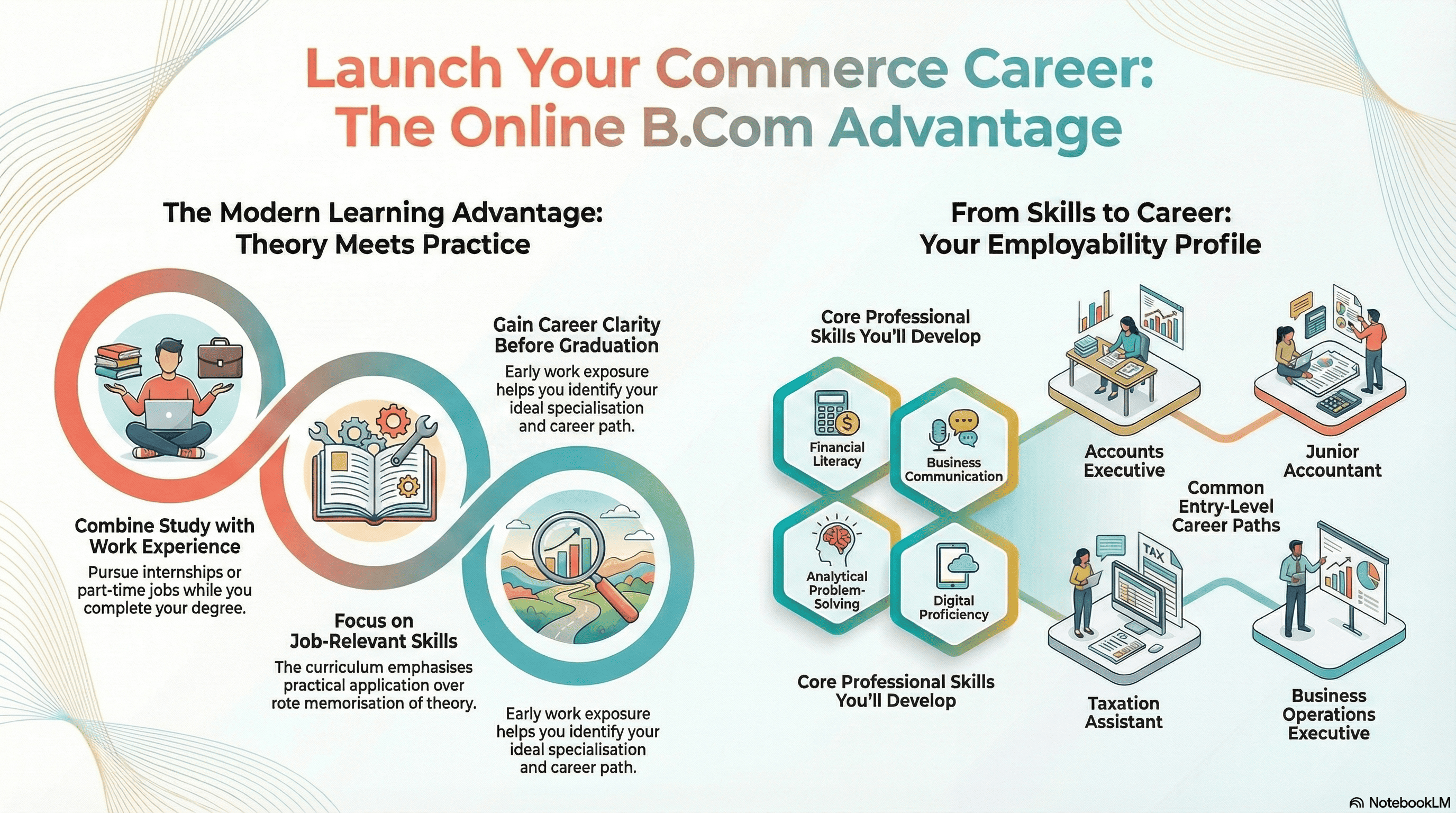
- Learn theory while observing its application in real organisations
- Build professional habits early, such as reporting, documentation, and compliance awareness
- Develop clarity about career paths before graduation, not after
This combination significantly alters how employable a graduate feels — and is perceived — at the end of the degree.
Skill Development Outcomes
One of the strongest arguments in favour of digitally delivered commerce education is its emphasis on skill formation. Beyond subject knowledge, students acquire competencies that are transferable across roles and industries.
Core Professional Skills Developed
The skills gained through online B.Com programs are closely aligned with workplace expectations in commerce and business environments. These include:
Financial literacy and accounting application
Students learn how financial statements are prepared, analysed, and interpreted — not just
for exams, but for audits, taxation, and managerial decisions.
Business communication and documentation
Regular assignments, reports, and presentations help students develop structured writing
and professional articulation — essential for corporate roles.
Analytical and problem-solving ability
Case-based learning strengthens the ability to evaluate scenarios, identify financial or
operational issues, and propose logical solutions.
Digital proficiency
Exposure to spreadsheets, basic financial tools, and data handling prepares students for
modern commerce roles where technology is integral.
Time management and self-discipline
Independent learning builds accountability — a skill often overlooked but highly valued by
employers.
Linking Education to Career Progression
Unlike conventional full-time formats, online programs allow students to test career interests early. This experiential overlap explains how online B.Com supports career growth even before graduation.
Students are able to:
- Take up part-time roles or internships during the degree
- Apply academic concepts directly in workplace settings
- Identify specialisations (finance, accounting, HR, operations) based on real exposure
As a result, graduates step into the job market with both qualification and direction — a combination that significantly improves employability outcomes.
Career Pathways
Commerce graduates have traditionally enjoyed broad career options, and this continues to hold true in digital learning formats. The opportunities after online B.Com extend across sectors, including finance, services, manufacturing, logistics, retail, and public administration.
Common Entry-Level Job Roles for Commerce Graduates
Below are key roles that B.Com graduates typically pursue, along with what each role involves:
Accounts Executive
Handles bookkeeping, ledger maintenance, invoice processing, and financial reporting
support within organisations.
Junior Accountant
Assists in preparing financial statements, managing audits, and ensuring compliance with
statutory requirements.
Taxation Assistant
Supports income tax filing, GST documentation, and regulatory submissions for individuals
or firms.
Business Operations Executive
Works across procurement, vendor coordination, and internal process management.
Banking and Financial Services Associate
Engages in customer handling, documentation, credit processing, and operational support in
financial institutions.
Sales and Commercial Analyst (Entry Level)
Analyses sales data, pricing structures, and revenue trends to support decision-making.
Each of these roles benefits from early exposure to applied commerce concepts — something online learners often gain alongside their studies.
The Role of Internships and Work Exposure
Professional exposure has become a decisive factor in employability. Many online programs actively encourage or support internships for B.Com students to ensure academic learning translates into workplace competence.
Internships help students:
- Understand organisational workflows
- Apply accounting, finance, or compliance concepts practically
- Build professional references and experience before graduation
In some programs, students also have access to structured work-linked learning models such as B.Com with Apprenticeship, where academic study is formally integrated with industry experience. This model allows learners to graduate with both a degree and documented professional exposure — a strong advantage in competitive job markets.
Program Design and Learning Experience
The effectiveness of an online commerce program depends heavily on its academic design. A well-structured online B.Com course structure balances foundational theory with application-oriented learning.
Typically, such programs include:
- Core subjects in accounting, economics, business law, and management
- Progressive exposure to taxation, finance, and corporate operations
- Assignments that mirror professional tasks rather than rote learning
Additionally, online B.Com curriculum insights reveal a growing emphasis on practical relevance — including case studies, scenario-based assessments, and skill-focused projects.
For students evaluating long-term credibility, pursuing a commerce degree through distance or online mode from a recognised institution ensures academic validity while offering modern learning flexibility. When choosing an online commerce program, institutional reputation plays a crucial role in long-term value. Universities that integrate academic rigour with work-linked learning models offer students both credibility and exposure.
For instance, Aligarh Muslim University online programs are structured to support apprenticeship-based learning, allowing students to align formal commerce education with practical industry experience — a model that reflects evolving expectations in higher education.
Key Benefits of the Program
Below are the major advantages, explained in detail:
- Early professional exposure – Students can gain work experience alongside academic learning, reducing the gap between graduation and employment.
- Skill-centric learning approach – Emphasis shifts from memorisation to application, helping students develop job-relevant competencies.
- Career clarity before graduation – Exposure to different roles during the degree helps students make informed career decisions early.
- Academic continuity with flexibility – Learners can continue their education without pausing employment or internships.
- Improved employability profile – Graduates enter the job market with both qualifications and experience, enhancing confidence and credibility.
Frequently Asked Questions
Closing Perspective
Commerce education is no longer just about earning a degree — it is about preparing for responsibility, accountability, and decision-making in real organisations. An online B.Com, when chosen thoughtfully, serves as both an academic foundation and a professional launchpad.
By integrating skill development, early exposure, and credible academic structure, this learning format aligns education with the realities of today’s job market — enabling commerce graduates to step forward with confidence, clarity, and capability.