
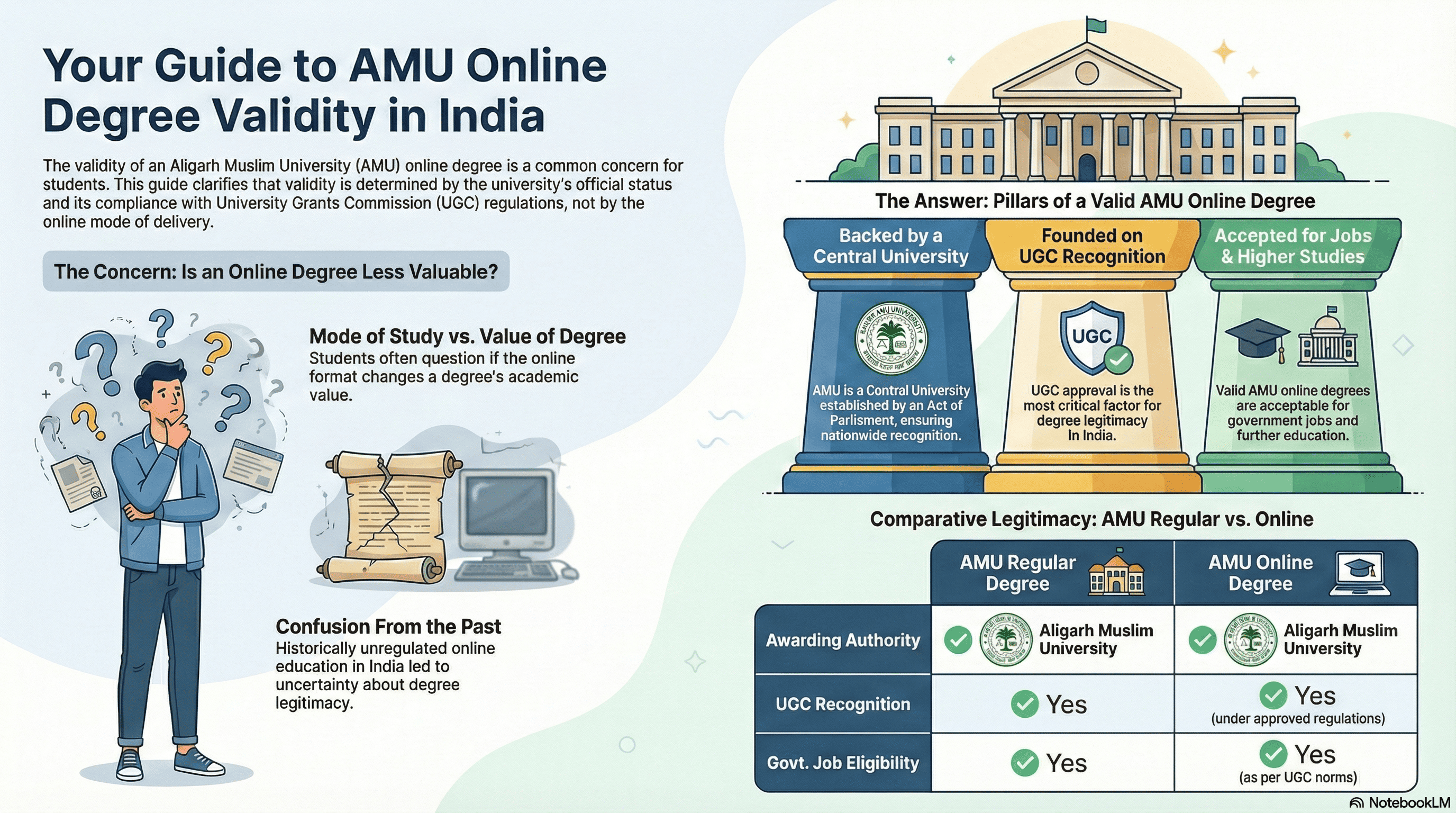
Questions around degree validity are not about paperwork alone. They reflect deeper concerns—career mobility, eligibility for higher studies, public sector opportunities, and long-term academic credibility. As learning formats evolve, especially through online education, learners naturally ask whether the mode of study changes the value of the degree.
This question becomes more pronounced when the institution involved has a long academic legacy. For learners considering online programs from Aligarh Muslim University, understanding validity is not a matter of reassurance—it is a matter of informed decision-making.
Takeaway: Degree validity is ultimately about institutional authority and regulatory alignment, not learning format alone.
- What does “validity” actually mean in the Indian education system?
- Is AMU an institution authorised to offer valid degrees?
- Is AMU’s online degree recognised by UGC?
- Are AMU online degrees valid for higher studies and government jobs?
- What kind of degree does AMU award in online mode?
- Is there a difference between AMU’s regular and online degree validity?
- How should students evaluate online degree validity responsibly?
- Conclusion
What does “validity” actually mean in the Indian education system?
In India, the validity of a degree depends on three core pillars:
- Institutional status (central, state, or deemed university)
- Regulatory approval by statutory bodies
- Recognition of the learning mode under applicable regulations
An online degree is considered valid when it is awarded by a recognised university and offered in accordance with guidelines issued by the University Grants Commission (UGC). This is the framework within which discussions around Aligarh Muslim University Online Degree validity must be placed.
Is AMU an institution authorised to offer valid degrees?
Aligarh Muslim University is a Central University established by an Act of Parliament. Degrees awarded by central universities carry nationwide academic recognition.
When such an institution offers programs through approved online or distance modes, the degree’s validity flows from:
- The university’s statutory status
- Compliance with UGC regulations governing online education
This is why questions like is AMU online degree accepted in India are answered not by opinion, but by regulatory structure.
Is AMU’s online degree recognised by UGC?
UGC recognition is the most critical factor in determining degree validity in India. Online programs offered by recognised universities must meet specific criteria related to curriculum design, delivery standards, assessment, and student support.
Programs such as the MA Apprenticeship offered under AMU’s approved online framework fall within this regulatory ecosystem, which directly addresses the question is AMU's online degree recognised by UGC.
Takeaway: UGC recognition is not optional—it is the foundation of degree legitimacy in India.
Are AMU online degrees valid for higher studies and government jobs?
Validity is often tested at two critical points: higher education admission and public sector eligibility. AMU online degrees are considered valid for higher studies and government jobs when they are awarded under UGC-approved frameworks. Eligibility in both cases depends on the recognition of the university and regulatory compliance, not on the mode of learning.
Similarly, for government jobs, eligibility is assessed based on recognition of the university and compliance with UGC guidelines rather than the mode of learning itself. As a result, an AMU online degree that meets these conditions is generally acceptable for both higher studies and public sector opportunities.
Takeaway: For most institutional and government purposes, recognition of the awarding university matters more than the mode of learning.
What kind of degree does AMU award in online mode?
A common misconception about online education is that it results in a different or lesser form of qualification. In reality, when an online program is offered under approved regulations, the degree awarded is issued by the university itself, not by a separate digital platform or third-party provider. In the case of AMU, the degree certificate is granted by Aligarh Muslim University as the awarding authority, reflecting the institution’s academic responsibility for the program.
The mode of learning does not alter the university’s role in evaluation, assessment, or certification. What matters is that the program is delivered and completed within the regulatory framework governing online education.
The academic authority of the degree remains with the university.
Is there a difference between AMU’s regular and online degree validity?
From a regulatory standpoint, validity is not defined by mode, but by recognition. However, learners often seek a clearer comparison.
| Aspect | AMU Regular Degree | AMU Online Degree |
|---|---|---|
| Awarding Authority | Aligarh Muslim University | Aligarh Muslim University |
| University Status | Central University | Central University |
| UGC Recognition | Yes | Yes (when offered under approved regulations) |
| Acceptance for Higher Studies | Yes | Yes (subject to institutional criteria) |
| Eligibility for Government Jobs | Yes | Yes (as per UGC norms) |
| Mode of Learning | On-campus | Online |
| Academic Value | Institution-based | Institution-based |
Takeaway: The distinction lies in delivery, not degree of authority.
How should students evaluate online degree validity responsibly?
Instead of relying on general opinions, learners should always check:
- Whether the university is recognised
- Whether the program is listed under approved online offerings
- Whether enrollment falls within valid academic cycles
This approach applies to all institutions offering online education, including Aligarh Muslim University Online Courses.
Conclusion
The validity of an online degree in India is ultimately determined by institutional authority and regulatory compliance, not by perception or delivery format. Aligarh Muslim University, as a central university established by Parliament, carries inherent academic legitimacy.
When its online programs are offered under UGC-approved frameworks, the degrees awarded are valid, recognised, and acceptable for higher studies and government employment. Understanding this distinction helps learners move beyond uncertainty and evaluate online education with clarity, confidence, and a long-term perspective.