
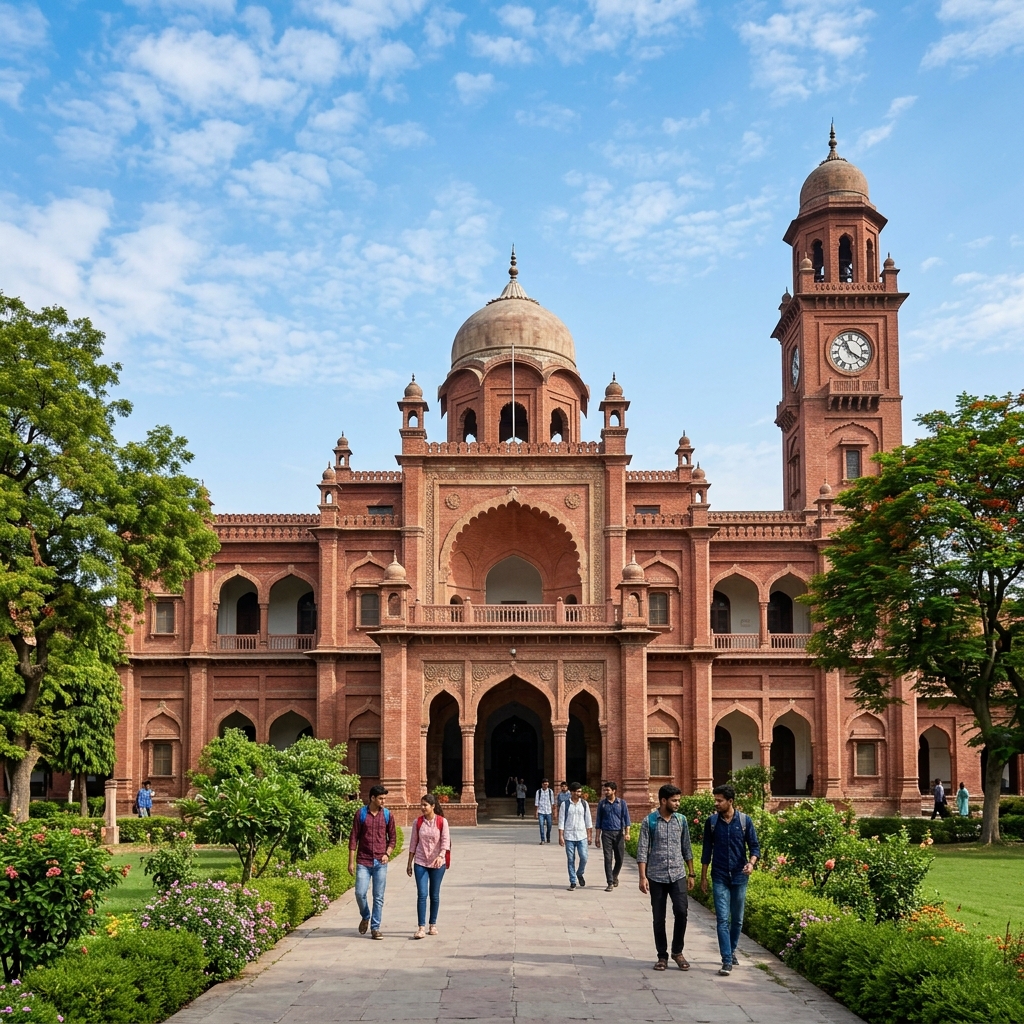
There is something worth interrogating in the phrase "brand name university." Students and families use it often, but what they mean by it varies considerably. Sometimes they mean prestige, the name that sounds impressive at a dinner table. Sometimes they mean outcomes of the institution that actually produce well-employed graduates. And sometimes, rarely, they mean something more difficult to quantify: an institution with a culture so distinct that it shapes the people who pass through it in ways that outlast the degree itself.
Aligarh Muslim University sits in a category that most Indian universities do not occupy. It is simultaneously a central university with the funding and recognition that designation carries, a historically significant institution with more than a century of academic legacy, and a residential campus that creates a learning environment qualitatively different from what most Indian students encounter in higher education. Understanding why students choose it and whether you should requires looking at all three of these dimensions honestly.
- What the Preference Signal Actually Means
- What Students Actually Experience: Three Portraits
- Should You Choose This Institution? An Honest Assessment
- What the Institution Is Built to Deliver
- What the Evidence Looks Like Up Close
- The Signals That Will Shape Its Value Over the Next Decade
- Key Takeaways
- Frequently Asked Questions
What the Preference Signal Actually Means
Every year, applications to AMU significantly exceed available seats across most programmes. Understanding AMU student preference requires unpacking what that demand is actually signalling. It is not simply brand recognition; there are institutions with stronger national NIRF rankings that receive less intense competition for certain programmes. The preference for AMU reflects something more specific: a combination of perceived academic quality, cultural identity, community belonging, and post-graduation outcome confidence that students and families weigh together.
The contrarian insight worth stating directly: prestige and fit are different things. A student who thrives in a structured, campus-immersive, academically rigorous environment will find AMU's culture genuinely enabling. A student who prefers metropolitan proximity, industry internship density, or a more loosely structured academic life may find themselves underutilising what the institution offers. Preference should be evaluated through the lens of fit, not just reputation.
What Students Actually Experience: Three Portraits
The Student Who Found Their Academic Home
Arrived from a smaller city, first-generation college student, strong academic record, but limited exposure to competitive institutional environments. Found in AMU, a campus that provided structure, peer accountability, and mentorship in a way that their home environment could not. The residential system forced engagement with peers from different states and backgrounds. Left with both a strong degree and a peer network that proved professionally useful within three years of graduation. Credits the campus environment as a formative influence, not just the curriculum.
The Student Who Underestimated the Environment
Enrolled primarily for the central university credential. Found the academic rigour steeper than expected and the campus culture with its own rhythms, traditions, and social codes more demanding to navigate than anticipated. Did not engage actively with faculty or student bodies. Completed the degree, but felt the experience was less transformative than peers who had invested more deliberately. The lesson: a strong institutional environment amplifies investment. It does not substitute for it.
The Student Who Came for Research Depth
Already holds an undergraduate degree from another institution. Chose this university specifically for postgraduate or doctoral work because of a specific department's research reputation and the accessibility of faculty mentors. Found the library infrastructure, research culture, and peer quality genuinely differentiated from what was available elsewhere in the region. Published work during the programme. Left with a stronger research profile than what any alternative programme in the same geography would have produced.
The thread connecting all three: the experience tracks closely with intentionality. Students who arrive knowing what they want to extract from the environment consistently report better outcomes than those who arrive expecting the institution to define the agenda for them.
Should You Choose This Institution? An Honest Assessment
The question should students choose AMU deserves a direct answer rather than a promotional one. The decision rests on four variables: your academic goals, your learning style, your career direction, and the specific programme you are evaluating.
Choose this institution if:
- You are targeting a discipline where the university has a nationally recognised department, including law, medicine, engineering, Arabic and Islamic studies, fine arts, and several social science programmes, which have strong reputations that travel beyond the region
- You value the residential campus model and will engage with it actively. The peer learning, cultural life, and alumni network that the campus generates are genuine differentiators, but only for students who use them
- You are seeking a central university credential with the funding stability, faculty quality benchmarks, and recognition that central university status provides
- You are a postgraduate or doctoral student looking for a research environment with established faculty mentorship and library depth in your subject area
Think carefully if:
- Your career target requires dense metropolitan industry networks, frequent corporate internship exposure, or proximity to specific technology or finance hubs. Geographic location is a real variable, and Aligarh is not a metro
- You are evaluating a programme that is not among the university's strongest departmental offerings. The quality differential between top and average programmes within any large institution is real
- You have not considered the campus culture fit question seriously. The residential environment has a distinct character that suits some students and frustrates others
What the Institution Is Built to Deliver
The AMU advantages for students begin with structural foundations that many institutions cannot replicate. As a central university, it receives direct funding from the central government, which translates into library infrastructure, research facilities, faculty positions, and scholarship mechanisms that state universities frequently cannot sustain at the same level. The university operates its own hospital (JNMCH), law school, engineering college, and school of fine arts, creating a campus ecosystem where professional and academic development happens within the same geographic and cultural space.
The breadth of programmes across undergraduate, postgraduate, and doctoral levels means that a student can, in principle, complete their entire formal education within the same institution, building continuity of faculty relationships and peer networks. This continuity is undervalued in most university selection conversations and overdelivered in practice.
What the Evidence Looks Like Up Close
Academic Environment and Faculty Quality
The question of is AMU a good university for students in academic terms is answered most clearly by looking at faculty credentials and research output by department. The university has produced and continues to attract faculty with strong research profiles in law, medicine, engineering, humanities, and Islamic studies. Departmental quality is not uniform across all 300-plus programmes, but the institution's top departments are competitive with national peers in NIRF assessments.
Campus Life and Environment
How is student life at AMU? It is one that students consistently find difficult to convey to those who haven't experienced it. The campus is self-contained in a way that few Indian universities replicate; it has residential halls, sports facilities, markets, a post office, hospitals, and cultural spaces within the campus boundary. This self-sufficiency creates an intensity of community that shapes students' social and professional identities in ways that commuter universities rarely do. Student bodies and unions are active; cultural and academic events run throughout the year; the sporting tradition is strong. The environment asks something of students' engagement, presence, participation and returns something commensurate with what is offered.
Campus Experience and Facilities
The AMU campus experience is inseparable from its physical architecture and historical continuity. The Maulana Azad Library is among the largest university libraries in Asia by collection size. Laboratories across science and engineering departments have received infrastructure investment under central funding schemes. The medical facilities at JNMCH serve both the student community and the wider regional population, giving medical students a clinical exposure volume that smaller institutions cannot match. Sports infrastructure includes facilities for cricket, football, athletics, and indoor games, competitive at the interuniversity level.
The Factors That Sustain Preference
Examining what factors make AMU popular among students across generations reveals something that goes beyond rankings or infrastructure. The institution has a cultural continuity, a sense of shared identity among students, alumni, and faculty that functions as a retention mechanism for prospective students from communities with historical ties to the institution. It also has a cross-community dimension that is sometimes underreported: students from diverse backgrounds across India enrol specifically for the quality of specific programmes rather than cultural alignment, and report finding the environment intellectually rigorous and socially substantive.
Why Students Return to This Institution Across Generations
Understanding why students prefer Aligarh Muslim University over structurally comparable options often comes down to a combination of factors that are individually insufficient but collectively compelling: the central university status, the residential campus model, the specific programme strength in their discipline, the scholarship and financial aid infrastructure, the alumni network depth, and for a significant portion of the student body the cultural and historical significance of the institution itself. No single factor drives the preference. The convergence of multiple factors does.
The Signals That Will Shape Its Value Over the Next Decade
Three developments are worth tracking as indicators of how the institution's value proposition will evolve.
First, the expansion of its online and distance education offerings is a structural opportunity. A central university's brand, attached to a well-designed online programme, reaches student populations that geography currently excludes. This is where the institution's next significant growth in reach without diluting the residential experience is most likely to come from.
Second, the increasing emphasis on research output and industry collaboration in NIRF and global ranking methodologies will pressure all Indian universities, including this one, to deepen industry partnerships and measurable research translation. Institutions that respond to this pressure proactively will see their rankings and employer perception improve. Those who treat their historical reputation as a sufficient substitute for current output will see erosion.
Third, the alumni network, already among the more cohesive of any Indian university, is becoming an increasingly important career infrastructure as formal placement infrastructure at most Indian universities remains underdeveloped relative to student need. Students who invest in their alumni relationships during their time at the institution will have access to a professional resource that many peers at other institutions will lack.
Key Takeaways
- Central university status provides structural advantages, funding, faculty standards, and scholarship access that most regional universities cannot match
- The residential campus model is a genuine differentiator, but only for students who engage with it actively and deliberately
- Programme quality varies; the decision to choose this institution should be evaluated at the department level, not just the institutional level
- Geographic location in Aligarh is a real variable for students whose career goals require metropolitan industry density or frequent corporate exposure
- Online and distance programmes extend institutional access without requiring relocation, and carry the same UGC-recognised credentials
- The alumni network is one of the institution's most underappreciated assets. Students who build these relationships during their programme leave with more than a degree
Frequently Asked Questions
📞 Ready to Build Your Future at AMU?
Reach out to the Aligarh Muslim University admissions team directly for programme details, eligibility, and application guidance.
Enquire NowWant to know more about the Aligarh Muslim University? Reach out to the Aligarh Muslim University admissions team directly for programme details, eligibility, and application guidance.